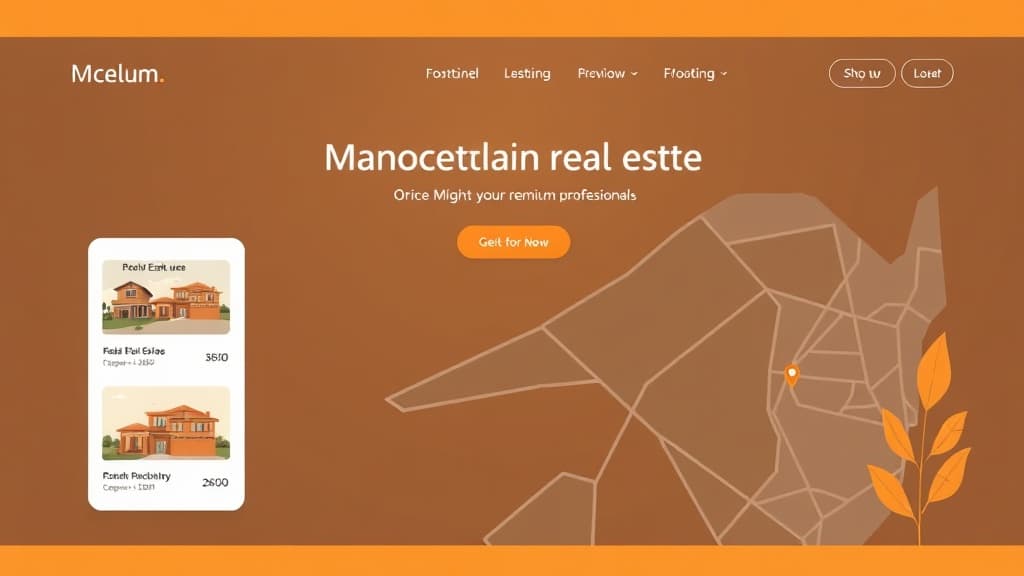
A real estate website is a lead generation machine — or it should be. Buyers and sellers research agents for weeks online before making contact. If your website looks outdated, loads slowly, or buries your listings, they move on to an agent whose site instills confidence. This guide covers exactly how to build a real estate website that generates qualified leads, showcases your listings, and establishes your authority in your market.
What Separates High-Performing Real Estate Websites
The top-performing real estate sites share these characteristics:
- IDX integration: Listing search connected to your MLS board so properties update automatically. Sites without IDX lose leads to Zillow and Realtor.com immediately.
- Hyper-local content: Neighborhood guides, school district pages, market report posts. Google rewards geographic specificity and buyers trust agents who clearly know their market.
- Fast load times: Real estate sites commonly fail speed tests due to large property photos and IDX widgets. Speed matters — 40% of visitors abandon pages that take more than 3 seconds.
- Clear lead capture: Every page should have an obvious, low-friction way to contact you or request a showing. Forms that ask for too much information upfront kill conversion.
- Mobile-first design: 70%+ of real estate searches happen on mobile. If your listing photos look broken on a phone, you're losing business.
Step 1: Choose the Right Platform for Real Estate
Real estate websites have specific technical requirements — especially IDX — that limits your platform choices:
- ZonedWeb (recommended for agents): Deploys professional real estate sites from a curated template catalog via ZonedWeb's real estate website builder. Built on real WordPress, which supports every major IDX plugin (Showcase IDX, RealPress, IDX Broker). Zoni AI generates your initial about, market, and service page content.
- WordPress + IDX plugin: The industry standard for independent agents who want full control. Popular combinations: Divi/Astra theme + Showcase IDX ($59.95/month) or iHomeFinder Optima Express. Most powerful option; most setup work.
- Placester: Real estate-specific builder with IDX built in. $99–200/month. Limited customization but faster setup for agents who want a managed solution.
- kvCORE / Follow Up Boss + website: Full CRM + website platforms designed for teams and brokerages. $500–1,500/month. Overkill for individual agents; appropriate for teams doing 100+ transactions/year.
The decisive question: do you need IDX listing search on your website? If yes, WordPress-based solutions give you the most control and best SEO performance. Proprietary real estate platforms often produce IDX pages Google can't fully index, wasting your marketing investment.
Step 2: Build the Essential Real Estate Pages
Every high-converting real estate website needs these core pages:
Home Page: Clear value proposition above the fold ('Austin's Top Buyer's Agent' or 'Selling Homes in [Neighborhood] Since 2010'). IDX search bar prominently placed. Links to featured listings. Social proof (number of transactions, client reviews). Two CTAs: 'Search Listings' and 'Get a Free Home Valuation.'
Search / Listings: Your IDX-powered search page. Configure default search to show your farm area. Featured or exclusive listings should appear above the IDX widget. Each listing page should be SEO-optimized with the address in the title tag.
Sellers Page: What you offer sellers — comparative market analysis, marketing strategy, staging advice, your negotiation track record. Include a home valuation widget (Home Value Leads, HouseValues.com embed, or a simple form to request a CMA). Sellers who find you via organic search are your highest-value leads.
Buyers Page: Your buyer representation process. First-time buyer resources. Neighborhood guides. A 'What Can I Afford?' mortgage calculator (embed from a lender partner or use a free WordPress plugin). 'Start Your Search' CTA links to your IDX search page.
Neighborhood Guide Pages: One page per neighborhood or zip code you serve. Format: market stats, school info, lifestyle description, recent sales data, and a filtered IDX search showing active listings in that area. These pages drive enormous organic traffic — 'homes for sale in [neighborhood]' is one of the most-searched real estate queries in any market.
About: Your story, credentials, and local market knowledge. Clients choose agents they trust. Real, specific credentials (local market stats you've sold in, certifications, years in market) outperform vague 'I'm passionate about real estate' statements.
Testimonials: Real client quotes with full name, transaction type, and ideally their photo. Video testimonials convert extremely well in real estate. Request them within a week of closing while the experience is fresh.
Step 3: Set Up IDX Property Search
IDX (Internet Data Exchange) gives you permission from your MLS board to display the full MLS listing database on your website. Setup steps:
- Get IDX approval: Contact your MLS board (NAR, state association, or local board). Most require signing an IDX participation agreement. Turn around is typically 3–10 business days.
- Choose an IDX plugin: Showcase IDX ($59.95/month) has the cleanest UI and best SEO. IDX Broker ($55–100/month) is popular with established agents. Both integrate deeply with WordPress.
- Configure your default search: Set the default geographic area to your farm. Add community-specific saved search pages for each neighborhood you serve.
- Enable lead capture: Require registration to see contact information or request a showing. Set this threshold thoughtfully — too early in the search process and you lose leads; too late and serious buyers disappear to Zillow.
IDX listing data is shared by all agents on the MLS. Your SEO advantage comes from the surrounding content — neighborhood guides, market commentary, hyper-local blog posts — that your competitors typically don't invest in.
Step 4: Win Local Real Estate SEO
Real estate SEO is local SEO. Your targets: '[city] real estate agent,' 'homes for sale in [neighborhood],' 'sell my home in [zip code].' How to rank for them:
- Neighborhood pages: One page per neighborhood. These are your highest-traffic, highest-conversion pages. Each should be 800–1,200 words covering: location, lifestyle, price range, school district, commute, and a filtered IDX search.
- Google Business Profile: Claim it, verify it with your NAR license number, add photos of closings (with client permission), and collect Google reviews after every transaction.
- Market report content: Monthly or quarterly market reports for your farm area ('Austin Real Estate Market Report — June 2026') rank well and establish your authority. Include actual MLS data.
- Backlinks from local sources: Get linked from local chamber of commerce sites, neighborhood association pages, and local news mentions. Each link from a local authoritative site boosts your local ranking.
- Consistent NAP: Your name, firm name, address, and phone must be identical on your website, Google Business, Yelp, Facebook, and Realtor.com.
Browse our real estate website templates — each designed with lead capture, IDX readiness, and local SEO best practices built into the layout.
Ready to build your real estate website? ZonedWeb's real estate website builder launches a professional, IDX-ready WordPress site from real estate templates with Zoni AI writing your initial content. Start building today — free to try.
Frequently Asked Questions
Do I need an IDX website as a real estate agent?
Yes, if generating buyer leads online is part of your strategy. Without IDX, visitors who want to search listings leave your site and go to Zillow, Realtor.com, or a competitor's site that has IDX. You lose the lead and the relationship. IDX keeps buyers engaged on your site and feeds them into your lead capture flow.
How much does a real estate website cost?
WordPress hosting + domain: $75–200/year. IDX plugin: $55–100/month. Premium theme: $0–200 one-time. Total DIY cost: roughly $750–1,400/year. ZonedWeb: $29–69/month all-in (hosting, theme, SSL, AI — IDX plugin subscription is separate as it requires MLS board credentials). Custom agency build: $5,000–20,000 for a real estate site with IDX. Most agents see strong ROI from even a $100/month investment given a single transaction commission.
Can I rank my real estate website against Zillow?
Not for national terms — Zillow's domain authority is too high. But you can outrank Zillow for hyper-local searches: specific neighborhood names, street-level searches, and long-tail buyer/seller queries. Zillow doesn't publish content like 'Best neighborhoods in [your city] for families with young children' or '[Neighborhood] market report Q2 2026.' You can rank for these with 800–1,200 word neighborhood guide pages.
How do I get leads from my real estate website?
Three proven lead capture mechanisms: (1) Home valuation tool — offer a free CMA in exchange for a name, email, and property address; (2) IDX registration gate — require email to see contact info or request showings; (3) Content lead magnets — 'Download the [City] Neighborhood Comparison Guide' in exchange for contact info. Combine all three for the highest lead volume.
How many pages should a real estate website have?
Minimum viable: 6 pages (Home, Search, Buyers, Sellers, About, Contact). High-performing: 15–30+ pages with individual neighborhood guide pages, blog posts, and resource pages. Neighborhood pages are the highest ROI pages you can add — each one targets a specific high-intent local keyword and builds your site's topical authority with Google.
Zoned Web
The ZonedWeb team builds the AI website platform that designs, writes, and deploys professional, SEO-ready sites — so you can launch in minutes, not weeks.